


Home > Product Line & Price List > ELASTUFF 120
ELASTUFF 120
100% Solids Polyurethane Coating
A protective surface coating that yields a tight, dense finish against wear, abrasion and corrosion in aqueous as well as dry environments.
Description
ELASTUFF 120 is a two component, 100% solids polyurethane elastomer coating containing no mocha or fillers such as clay or mica. It was formulated for protecting surfaces subject to traffic and abrasion, and for protecting them from all aqueous environments, including fresh water, salt water, slurry systems, and numerous acid and base solutions. It is equally effective under dry abrasive and/or damp corrosive environments.
ELASTUFF 120 is a highly cross-linked polymer coating, yielding a dense, tight finish. Its nonporous surface and excellent hydrolytic stability make ELASTUFF 120 an excellent barrier to wear and corrosion. The high tensile strength of ELASTUFF 120 contributes to its resistance to abrasion and tearing. This toughness, combined with its elongation properties, also results in outstanding flexibility and impact resistance. ELASTUFF 120 is a solventless system enabling fast, high-build coats without solvent entrapment.
Basic Uses
ELASTUFF 120 is used over a wide variety of vertical and horizontal wood, fiberglass, concrete, and polyurethane foam surfaces.
Typical applications include wood decks (boat and home), wood boat hulls, fiberglass deck and hull surfaces, wood or concrete steps, walkways, lanais, swimming pools, pool decks, tennis courts, parking areas, garage floors and concrete top surfaces.
The vertical hold attained by ELASTUFF 120 gives it the ability to uniformly cover coarse or pitted wood, concrete and other irregular surfaces.
Color

(Part A is clear; Part B is Charcoal Gray. Combined mix is Charcoal Gray.)
| ELASTUFF 120 Typical Properties | |
|---|---|
| Mixing Ratio: | 1 Part A to 1 Part B (1A:1B) |
| Mixed Usable Pot Life: | 20 minutes @ 75°F (24°C), 50% R.H. |
| Dry Time to Touch: | 4 hours tack free @ 75°F (24°C), 50% R.H. |
| Cure Time: | 90% after 24 hours @ 75°F (24°C), 50% R.H. [ASTM D1640] |
| Water Absorption: | Less than 1% weight gain after 7 days [ASTM D570] |
| Tensile Strength: | 1,300 psi [±100] (9.0 MPa) [ASTM D412] |
| Elongation: | 150% (±20) [ASTM D412] |
| Tear Strength: | 200 lbs/in [±30] (35 N/mm) [ASTM D1004] |
| Hardness: |
30–40 Shore D @ 75°F (24°C) [ASTM D2240] 40–50 Shore D @ 35°F (2°C) [ASTM D2240] |
| Abrasion Resistance: | 20–30 mg. weight loss with CS-17 wheel [ASTM D4060] 50–70 mg. weight loss with H-10 wheel using 1000 gm weight at 1000 revolutions [ASTM D4060] |
| Low Temperature Flexibility: | Passes 1/4 inch (6 mm) mandrel bend @ -4°F (-20°C) [ASTM D522] |
| Low Temperature Impact Resistance: | Passes 160 inch pound (18.1 Joules) direct @ -4°F (-20°C) |
Surface Preparation
All surfaces should be dry and clean, free from any dirt, grease, oil, pollution fallout, smoke, wax, form release agents, surface chemicals, or other foreign contaminants which could interfere with proper adhesion. Surfaces should be free of sharp projections, ridges and loose aggregate.
 Wood: ELASTUFF 120 can be applied directly to clean new wood. To additionally protect the wood, one or more coats of S-1™ Clear Penetrating Epoxy Sealer can be applied first, including all seams and edges, and allowed to cure. All cracks larger than hairline should be considered as “moving” and be cleaned and filled with either SculpWood® Epoxy Paste or Putty or a polyurethane sealant, such as our Dymonic® 100. Any of these fillers should be troweled flush with sufficient pressure to fill the cracks and joints completely. At least 2 generous coatings of ELASTUFF 120 are required on top of the primed or unprimed surface. Each additional coat should be applied perpendicular to the original coating.
Old wood or restored wood should be clean and bare and free of any foreign contaminants. We strongly recommend a prime coating of S-1™ Clear Penetrating Epoxy Sealer if the wood shows any signs of deterioration, softness or rot. After the sealer has completely dried/cured, existing hairline cracks should be filled with SculpWood® Epoxy Paste or Putty or a polyurethane sealant, such as our Dymonic® 100. Any of these fillers should be troweled flush with sufficient pressure to fill the cracks and joints completely. At least 2 generous coatings of ELASTUFF 120 are required on top of the primed surface. Each additional coat should be applied perpendicular to the original coating.
For plywood it is beneficial if all side and end-grain surfaces are completely waterproofed with ELASTUFF 120, or an epoxy resin such as our General Purpose Epoxy™ Resin, or sealed from any moisture penetration with 3 applications of S-1™ Clear Penetrating Epoxy Sealer.
 Fiberglass: Fiberglass should be scuffed and cleaned
with M.E.K. before ELASTUFF 120 is applied. The surface should be primed with S-1™ Clear Penetrating Epoxy Sealer. At least 24 hours should pass between the application of the primer and the application of ELASTUFF 120. At least 2 generous coatings of ELASTUFF 120 are required on top of the primed surface. Each additional coat should be applied perpendicular to the original coating.
Fiberglass: Fiberglass should be scuffed and cleaned
with M.E.K. before ELASTUFF 120 is applied. The surface should be primed with S-1™ Clear Penetrating Epoxy Sealer. At least 24 hours should pass between the application of the primer and the application of ELASTUFF 120. At least 2 generous coatings of ELASTUFF 120 are required on top of the primed surface. Each additional coat should be applied perpendicular to the original coating.
 Concrete: Concrete which will be subject to immersion
conditions must be blast cleaned. Concrete subject to non-immersion conditions
can either be blast cleaned to roughen the surface or acid etched, so long as
the etching provides an even profile of 5 to 8 mils. The surface preparation must
remove all loose, weak or powdery concrete to expose all voids and provide the necessary profile for mechanical adhesion of the ELASTUFF 120.
Concrete: Concrete which will be subject to immersion
conditions must be blast cleaned. Concrete subject to non-immersion conditions
can either be blast cleaned to roughen the surface or acid etched, so long as
the etching provides an even profile of 5 to 8 mils. The surface preparation must
remove all loose, weak or powdery concrete to expose all voids and provide the necessary profile for mechanical adhesion of the ELASTUFF 120.
Concrete surfaces which are contaminated with oil, grease, dirt, chemicals, etc. should be cleaned prior to blasting or acid etching with a biodegradable chemical cleaner and water. Cleaning should be accomplished using mechanical scrubbers and/or high pressure power washing equipment. Rinse thoroughly to remove all traces of the cleaner.
Acid etching should be done with a 10% Muriatic acid solution. The solution should be sprinkled onto the concrete surface. After the solution has stopped bubbling or foaming (normally 5 to 10 minutes) the area should be scrubbed thoroughly by hand or by using mechanical scrubbers. After scrubbing, all surfaces should be thoroughly rinsed with liberal amounts of fresh water to assure complete acid removal. Surfaces may require additional rinsing or a high pressure rinse to remove all traces of the acid solution.
Any resurfacing or repairs necessary to achieve a sound, consistent surface, free of bugholes, voids, cracks or spalling shall be completed prior to priming. After repairs are completed and adequately cured, concrete surfaces should be primed with one (1) coat of S-1™ Clear Penetrating Epoxy Sealer. Sealer shall be applied by roller, brush or airless spray at the rate of 250 sq. ft. per gallon (6 sq. meters/liter). Allow a minimum of 1 hour dry time at 75°F (24°C) between application of S-1™ and the application of ELASTUFF 120. Colder temperatures will require additional dry time. The sealed surface should be topcoated within 24 hours and should under no circumstances be left exposed longer than 48 hours.
Coating Application
Coverage
On horizontal surfaces, apply ELASTUFF 120 by pouring an “S” pattern across a 3′ to 6′ (9 to 18 dm) section of the substrate, then spread evenly to the desired thickness using a roller, squeegee, trowel or brush. It can also be applied directly with a brush, like thick paint. On vertical surfaces, a long nap roller is most effective, although again a brush can be used. On vertical surfaces the coats must be thinner to avoid coating sag. We suggest you cover a small test section first to become familiar with the coverage rate.
ELASTUFF 120 applied at the coverage rate of one gallon per 100 sq. ft. (2.5 sq. meters/liter) of the combined Part A and Part B will theoretically yield 16.0 dry mils (406 dry microns)*. The following dry mil thicknesses* are provided for guideline use only for typical applications:
Light Abrasion
(Dry or Immersion)
32 to 40 mils
(813 to 1,016 microns)
Medium Abrasion
(Dry or Immersion)
45 to 60 mils
(1,143 to 1,524 microns)
Heavy Abrasion
(Dry or Immersion)
80 to 120+ mils
(2,032 to 3,3048+ microns)
*The theoretical mil thickness given for coverage per gallon is based on smooth, nonporous surfaces. Actual gallons required to achieve the minimum dry mil film thickness will depend upon the surface texture, ambient weather conditions and technique of the applicator.
- Allow each coat of ELASTUFF 120 to dry tack free prior to applying an additional coat. This will require approximately 4 hours at 75°F (24°C).
- All surfaces must be uniformly coated and free of voids, pinholes or blisters. Old wood can produce air bubbles as the ELASTUFF 120 fills internal vacancies in the wood. These can be sanded clean after the ELASTUFF 120 has fully cured and before any topcoating is applied.
- Ambient temperature range for application is from 40°F to 100°F (4°C to 38°C). ELASTUFF 120 may be applied in high humidity conditions up to 90% R.H. In-service temperature limits for dry heat exposure range from 210°F (99°C) to a minimum of -60°F (-51°C).
- At temperatures above 70°F (21°C) ELASTUFF 120 will set quickly if kept in the container after mixing. At higher application temperatures ELASTUFF 120 should be mixed and immediately poured across the surface and spread to the desired thickness. We do not recommend applying ELASTUFF 120 at temperatures above 80°F (27°C). But if you must, we suggest cooling the cans prior to mixing by refrigeration or by immersing the cans in cold water up to (but not over) the rims. At higher temperatures Elastuff is best applied by two people, one to mix and the other to apply. Extra rollers/brushes should be on hand to replace those on which the Elastuff has started to cure.
- A polyester or fiberglass mesh may be embedded into the first coat of ELASTUFF 120 to help cover and reinforce large cracks, seams or voids.
- ELASTUFF 120 is self-flashing at natural termination points such as expansion joints, deck edges, gaps between decking boards, corners, edges, etc.
- ELASTUFF 120 can be diluted up to 15% with M.E.K. if a thinner coating is desired.
Topcoat Application
ELASTUFF 120 is designed as a functional coating system providing a durable, abrasion and chemical resistant waterproof membrane on a wide variety of surfaces and service conditions. It will lose its sheen and may chalk slightly after extended exterior exposure. For this reason, it is recommended that ELASTUFF 120 be topcoated in areas where aesthetics are of prime importance, or when a color other than standard charcoal gray is desired. Elasta-Tuff™ 6000-AL-HS is typically used when service conditions are severe. RHINO TOP can also be used under less severe conditions.
Packing & Mixing
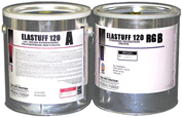
ELASTUFF 120 is a two component coating available in (2) one gallon units.
Two Components: Part A is Clear and Part B is Charcoal Gray. With a paddle or power mixer, mix each container separately until the material is of uniform color and consistency. Be sure to clean the power mixer thoroughly between containers to avoid contamination, or use separate power mixers. Then, blend equal parts of Part A and Part B into another container to yield the standard Charcoal Gray color for application.
Cleanup
Use MEK or Methylene Chloride.
Shelf Life and Storage
Shelf life of Part A and Part B components in unopened containers is 6 months from date of shipment. Material must be stored at temperatures between 50°F and 100°F (10°C and 38°C). Do not open the containers until ready to use the material.
ELASTUFF 120 components are affected by moisture prior to catalyzation and must be protected from moisture contamination. Keep all containers tightly closed during storage. Unopened containers are factory sealed with an inert gas to prevent contamination. After opening and if all components are not to be used, containers should be tightly sealed to protect components from moisture contamination. Storage under these conditions should not exceed 3 weeks, although this may vary depending on the amount stored and the ambient atmospheric conditions when the containers are closed.
Precautions
Use only in a well ventilated area. If used indoors, provide mechanical exhaust ventalation. Avoid contact with eyes and contact with skin. Avoid breathing of vapor or spray mist. Use approved (MSHA/OSHA) chemical cartridge respirator with particulate filter.
WARNING: Elastuff 120 uses an isocyanate catalyst. While no exposure limits have yet been set, NIOSH recommends the use of a N95 or better particulate pre-filter, particularly if used in enclosed environments. Our pre-filters are N95 rated.
Elastuff 120 is a hazardous product. Check the shipping options page for details on shipping hazardous items. For additional information refer to the Elastuff 120 Safety Data Sheet.
PDF Documents
You will need a PDF reader to view these links, you can download Acrobat Reader for free from Adobe’s website.
Safety Data Sheets: Part A and Part B (both parts are needed, they are separate sheets)