


Home > Product Line & Price List > Fill-It™ Epoxy Filler
Fill-It™ Epoxy Filler
- An Overview
- Application Guide
- Easy Instructions
- Tips and Techniques
- Cure Time Chart
An Overview
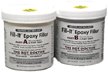
Using hydrogen bonding technology, this is a high strength, light weight, non-sagging and easily sanded epoxy filler. It consists of an epoxy resin and a curing agent derived from wood resins, which makes it very compatible with wood. It is reinforced with short glass fibers for tensile strength. Used with Clear Penetrating Epoxy Sealer™ as a base coating, it forms a tight molecular bond for long term stability and moisture resistance.
Fill-It bonds well with all clean fiberglass surfaces and can be used effectively to fill holes, cracks and depressions in the fiberglass. If applied to a smooth gel-coated surface, lightly sand the glass surface and wipe down with lacquer thinner or acetone before applying the Fill-It to the surface.
In addition, Fill-It bonds well to any properly prepared surface of wood, metal, glass and most plastics. There are some plastics that epoxies do not like to bond to, primarily in the polyethylene family. These are the types of plastics commonly used in margarine containers and Tupperware, as well as Saran Wrap-type plastic kitchen wrap. The best bonding surface is clean of oils or other contaminants, and scuff sanded with a scotch pad or medium grit sandpaper. Fill-It bonds exceptionally well to surfaces that have been treated with CPES first.
Packaging
Fill-It is available in 12 oz, 2 Pints and 1 Gallon units.
Easy Instructions
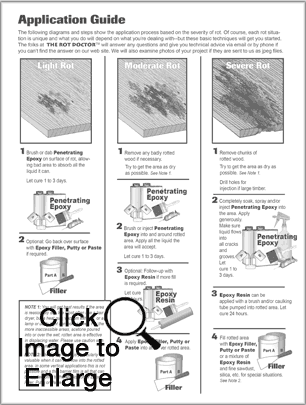
The two components are mixed 50:50 by volume to become a gel-like paste which may be faired and worked to a feathered edge. It cures overnight, and then can be carved, drilled without cracking, or primed/painted. See diagram at upper right. Pilot holes for screws and nails will need to be pre-drilled prior to the insertion of the fastener.
Tips and Techniques
Fill-It is most easily mixed on a flat, smooth board. Equal amounts by volume are put on the board surface, and then folded, swirled and chopped until a consistent color is obtained. There is a ± 10% mix-error margin so volume amounts can usually be judged by eye. If the Fill-It mix is going to be color-toned with our Epoxy Coloring Agent, the toning colorant can be added in small amounts after the Fill-It is mixed. If you wish to mix by weight the ratio is nine parts A to ten parts B.
If required, the mix can be loaded into our re-usable caulking tubes for pumping into vacant areas. If the tip is cut off the tube nozzle first so it can vent air, the 10 oz caulking tube can be completely loaded with one of the tongue-depressors supplied with the Re-Usable Caulking Tube kits.
Best results using Fill-It Epoxy Filler are obtained by first smearing a thin film against the surface, or if filling a cavity, working a small amount into all the holes and crevices with a putty knife, or the tip of the caulking tube. Additional material can then be added immediately to build the required thickness. For very large areas where sagging may occur, two or more applications may be necessary. Uncured Fill-It filler may be smoothed by placing a thin film of polyethylene over the material and using a squeegee or similar tool to smooth-out through the plastic. The plastic can be easily removed after the filler has cured. Sanding before painting is recommended.
In deep vertical or overhead applications the filler may sag away under its own weight. Fill to the point of sagging, allow to cure (see cure time chart bellow), and then come back and complete the fill.
ALWAYS MIX THOROUGHLY!
IMPROPER MIXING IS THE GREATEST CAUSE OF EPOXY SYSTEMS FAILURE.
FILL-IT™ EPOXY FILLER • CURE TIME CHART |
|||
|---|---|---|---|
| Pot Life | Cured To Sand | Full Chemical Cure | |
| 100° F (38° C) | 1/2 hr. | 3 hrs. | 10 hrs. |
| 70° F (21° C) | 1 1/2 hrs. | 8 hrs. | 24 hrs. |
| 55° F (13° C) | 3 hrs. | 16 hrs. | 2 days |
| 40° F (4° C) | 6 hrs. | 32 hrs. | 4 days |
| 28° F (-2° C) | 16 hrs. | 3 days | 10 days |
NOTE: Cure and recoating time will vary depending upon ambient conditions and the type of topcoat being applied. High humidity and/or low temperature will retard cure and recoat times
Fill-it Epoxy Filler is a hazardous product. Check the shipping options page for details on shipping hazardous items. For additional information, refer to the Fill-it Epoxy Filler Safety Data Sheet.
PDF Documents
You will need a PDF reader to view these links, you can download Acrobat Reader for free from Adobe’s website.
Safety Data Sheets: Part A and Part B (both parts are needed, they are separate sheets)