


Home > Product Testing > Plywood Preservation Test

Plywood Preservation Test: CPES™ Treated vs. Untreated Plywood, after 5 years of extreme exposure.
Plywood used outdoors is highly vulnerable to water absorption, which can lead to delamination and rot. On decks, home siding panels, boat flooring and hulls, bathroom/kitchen floors, plywood deterioration is a common problem. Paints and common wood sealers can keep out the moisture temporarily, but paints/sealers vary in their ability to do this and they often open and crack and allow moisture into the wood. This can produce an “incubator” effect, the paint trapping the moisture and heat which promotes the development of wood delamination and rot. Fiberglass with polyester resin over plywood often produces the same result.
The application of CPES™ (Clear Penetrating Epoxy Sealer) to the wood after it has been cut and trimmed for installation virtually eliminates the chances of delamination and rot developing, as the results of our testing show.
In conjunction with testing the coverage and durability of our new polyurethane coatings (click here to see the results of that test), we bought standard untreated 3/4″ (19 mm) exterior grade plywood panels, treated them on all sides and edges with one generous coating of CPES, except on the section that was coated with RHINO TOP. The top of the panels were coated with various combinations of RHINO TOP, ELASTUFF 120, and UNIFLEX 255 Aliphatic (since Uniflex 255 is no longer available please use our Elasta-Tuff™ 6000-AL-HS instead). We then put the panels outside on a driveway where they were completely exposed to weather, foot traffic, and light automotive traffic. This was done in Seattle, where there is lots of rain, some snow, hail and during the summer even some sun.
All test panels may be viewed in larger versions by clicking on the photo.
Results
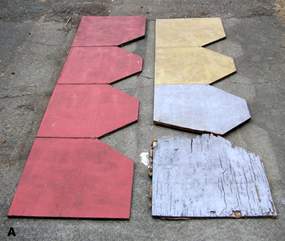
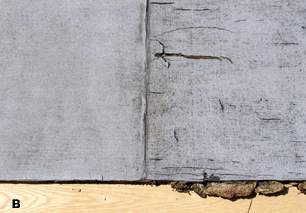
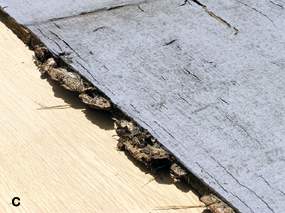
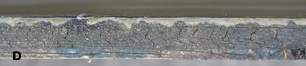
The results of this test were dramatic. Pictured is a photo (A) of the panels, showing the one section that was untreated with CPES and which broke loose from the treated section of the panel. It was completely rotted. Also shown is a vertical shot of the panel (B) which shows surface degradation and large fungal growth on the untreated edge, and no fungal growth or surface degradation to the left on the treated panel. Photo C shows a closer angle shot of the fungal growth. By comparison, we show an edge shot of the CPES-treated edge (D). It shows some light checking after five years, but if poked with a screwdriver is solid, and unaffected by any type of growth. All CPES treated edges were unaffected. Even the plywood core material is intact and solid.
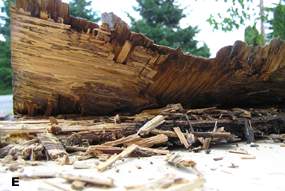
The first evidence that this was happening to the untreated panel came after 18–24 months exposure. We decided to let the rot run its course, which it did as you can see from this ground-level picture of the rotted and separated panel (E) after nearly 5 years exposure.
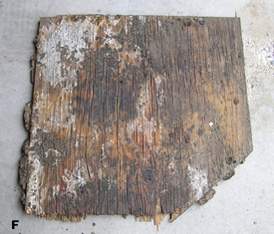
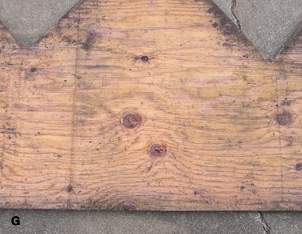
The bottoms of the panels are an interesting comparison, as well. Photo F shows the bottom of the non-CPES treated panel, discolored, cracked, and rotted. By comparison, Photo G shows the bottom of a CPES-treated panel, relatively clean, unbroken and no rot. These panel bottom have not been rinsed or cleaned. The discoloration at the edges of the CPES-treated panel is dirt and driveway residue. The wood itself is solid.
Conclusions and Recommendations
1) CPES™ makes plywood extremely resistant to rot, and will produce the same results on any wood it is applied to.
2) Nothing will bond with wood better or longer than epoxy and no epoxy mix will penetrate wood better than CPES. CPES is composed of a premium, wood-derived epoxy and a complex mixture of carrier solvents which carry the resin into the wood. The carrier solvents gas-off and leave the wood fibers encapsulated with epoxy resin. Any paint, varnish, epoxy resin or polyurethane can then be used as a final coating.
3) If you treat your plywood with CPES, we recommend that you do not use pressure-treated plywood. Most of the “treated” wood you buy is treated with chromated copper arsenate in a water and paraffin emulsion. The paraffin is to “waterproof” the wood, which it does, superficially, for a short while. Cut edges are still highly vulnerable to water absorption, and subsequent rot.
4) Coverage for CPES on good plywood will be approximately 200–250 sq. ft. (5–6 sq. m./l.) per gallon. Plywood edges should be treated generously.
For more details on the 5-year polyurethane coating results, click here.