


Rotten‘Zine
Rotten‘Zine a division of The Rot Doctor, Inc. All rights reserved.
Table of Contents
Removing fiberglass from a plywood hull
By Dan Roberts
January 13, 2006
EDITORIAL NOTE: “We get quite a few inquiries about removing paint and fiberglass from wood. Dan was kind enough to send us this outline (with pictures) about a clean, quiet and efficient way to remove either from a surface. We thank him!” -Dr. Rot
Note: all images can be seen in larger versions by clicking on them.
Dear Rot Doctor,
From Practical Sailor comes a quote: (See Link 1*)
“There is no reason to remove fiberglass that is adhering to a plywood hull or deck. If the glass has separated in small areas, grind the loose glass away down to the plywood, then reglass the exposed section. The only practical way to remove fiberglass is by sanding or grinding with a disk sander, a tedious and messy job. You must take care when grinding not to remove the surface layer of veneer from the plywood, so this is a job which requires a certain amount of care.”
I have found a better way to remove fiberglass from a plywood hull.
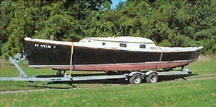
I bought a rare boat. Designed by Howard I. Chapelle back in the 1930’s, it is a 30′ double ended sharpie cruiser (built in 1971) whose lines can be seen in Chapelle’s book, Boatbuilding. I doubt if many of this design have ever been built, so I figured if it was worth buying, it was worth restoring to a high degree and I was determined to remove the polyester/fiberglass outer covering both to better enable an assessment of what needed doing and to upgrade it to epoxy saturation later in the process.
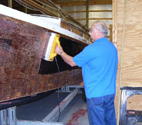
Searching the internet for various methods of paint stripping, I stumbled across the Speedheater infrared paint stripper made in Sweden and sold on the web by several dealers online for nearly $500.00. (See Links 2* and 3*.) A high price? Maybe, but it has the advantage of being easy, relatively clean and faster than you may think.
The instructions say to hold it in place for 20 – 30 seconds then scrape off the paint… and it works like a charm. But it will also loosen/soften the polyester resin holding the layers of glass cloth to the hull and after cutting around the 12″ x 5″ heat affected zone with a razor knife, a corner can be lifted, grabbed with a pair of pliers and simply peeled off in one piece. All this in about 45 seconds or so.
It is quiet, easy work that would probably be mind-numbing were it not for the Jimmy Buffet music filling my shop.
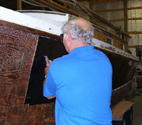
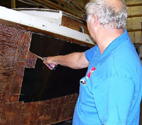
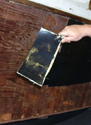
The result leaves some cured polyester resin on the hull which is easily sanded off with a palm sander. I test sanded a small area. But I have a new solution to speed that up too… Microplane, known for their cheese graters and wood forming tools has come out with stainless steel sanding discs they claim work 9 times faster and will last as long as 30 – 40 regular sanding discs. They are available from all the usual woodworking suppliers, come in coarse, medium & fine grits, and they cost around $10.00 /pair. I’ll let you know how they perform.
Regards,
Dan Roberts
Salisbury, NC
Links:
1* http://www.practical-sailor.com/newspics/charts/86Questions12.pdf
— EDITOR’S NOTE: This link listed as given no longer works but Practical Sailor is still up and running, so we are linking you to their site, but not the article originally given.
2* http://www.speedheatersystem.com
EDITOR’S NOTE: Dan informed us that the stainless steel sanding discs did not work well in his application. Dan also reported that when he contacted Microplane about the problem, they said they were coming out with improved discs.